Guide
Skin supplements: a plain guide before you buy anything
A product-neutral guide to the skin-supplement shelf. What skin actually needs, why a nutrient helps only where there was a shortfall, why glow and firmness cannot be measured, what a daily value is, and the five things that outrank any capsule. Gelagen appears once, in the last section.
By the Gelagen Editorial Desk · Last updated September 22, 2026
Start here
What skin actually is, before anything goes in a basket
Skin is an organ that replaces itself continuously, and most of what people want from a supplement is happening in a layer the supplement never reaches directly.
Skin has an outer layer that acts as a barrier and replaces its cells on a cycle of weeks, and a deeper layer where the structural proteins sit and turn over on a cycle of years. That gap between weeks and years is the first honest thing to know about this category: anything you notice inside a month is happening at the barrier, not in the structure.
What the barrier needs is unglamorous. Water, sleep, protection from ultraviolet light, and enough of a handful of nutrients that the body cannot make for itself. Most of that list does not come in a bottle, and the part that does only matters if you were short of it to begin with.
This page has nothing to sell. It exists so that the decision you make further down this site is made with the category in view rather than one label.
The shortfall rule
A nutrient supplement helps where there is a gap, and not otherwise
This one idea explains most of what is confusing about this aisle.
Nutrients work like a missing component rather than like a dial. Vitamin C is required to build collagen, so someone genuinely deficient in vitamin C has skin that does not heal properly, and correcting that deficiency fixes it. Someone who already eats an orange does not get a second improvement from a third orange. The requirement is met, and the surplus is surplus.
This is why an honest answer in this category so often begins with a question about your diet rather than about the product. the NIH zinc fact sheet puts it plainly for one of the nutrients on every skin label: most people in the United States get enough zinc from the foods they eat. If that describes you, a quarter-dose of zinc in a gummy is not doing anything you needed done.
None of that makes supplements pointless. Shortfalls are real, they are more common in some groups than others, and a blood test is how you find out whether you have one. It does mean that a bottle chosen because of a word on the front is being chosen at random.
Glow, hydration, firmness
Three words that cannot be measured, on every bottle in the aisle
Walk the shelf and the same three claims repeat. They are not lies, exactly. They are unfalsifiable. There is no agreed test for glow, no threshold for firmness and no number that hydration has to reach, so no bottle can be shown to have failed at them and none can be shown to have succeeded.
That matters because it leaves the shelf undifferentiated. If every label makes the same unmeasurable promise, the promise carries no information, and the only thing left that does carry information is the panel on the back: which nutrients, how much of each, and how that compares with a published reference.
So the practical move is to stop reading the front. Turn the bottle over, read the amounts, and treat the front as decoration until the back has earned it.
The daily value
What the percentage on a panel is measured against
It is one number for a whole adult population, printed so that labels can be compared with each other.
A Daily Value is a single reference figure the FDA sets for labelling purposes. It is not your personal requirement, it is not a target to hit and it is certainly not a score. Its job is to let you look at two panels and see that one carries twice as much of something as the other.
Reading a percentage, then, is a three-step exercise. Find the amount. Find the Daily Value it is being measured against. Then ask what being under, near or over that reference actually implies for that specific nutrient, because the answer is different for each one. Twenty-five per cent of the zinc reference is a top-up. Twenty-five per cent of the vitamin A reference sits inside a different conversation entirely, because vitamin A accumulates.
Two cautions. A panel may print an amount with no percentage beside it, which usually means no Daily Value has been established for that ingredient rather than that the amount is small. And a percentage can be computed by the site you are reading rather than printed on the bottle, which is the case everywhere on this site and is labelled as such on every page it appears.
Where the four usual nutrients sit
Vitamins A, C and E and zinc, with the reference values behind them
| Nutrient | Adult reference | What is worth knowing |
|---|---|---|
| Vitamin A (preformed) | 900 mcg RAE for adult men, 700 for women; upper limit 3,000 mcg | Real and specific. It is also the nutrient on this shelf where too much is a genuine problem: NIH lists severe headache, blurred vision, nausea, dizziness, muscle aches and coordination problems from too much preformed vitamin A, and warns that too much in pregnancy can cause birth defects. |
| Vitamin C | 90 mg is the labelling Daily Value | Your body cannot build collagen without it, which is the single most quoted line in this aisle. It is a statement about a shortfall being corrected, not about extra doing extra. |
| Vitamin E | 15 mg is the labelling Daily Value | An antioxidant found in nuts, seeds and vegetable oils. Shortfall is uncommon on an ordinary diet, and the natural-source d-alpha form is the better of the two on a label. |
| Zinc | 11 mg for adult men, 8 mg for women; upper limit 40 mg | NIH says zinc helps wounds heal, and in the same breath that most people in the United States get enough zinc from the foods they eat. Both halves of that sentence belong on a label discussion. |
Read that table for the third column rather than the second. The reference values are easy to look up; what they imply is the part a sales page leaves out. Vitamin A is the nutrient in this group where more is genuinely worse past a point, and it is also the one that is quietly present in a lot of products at once.
What outranks any capsule
Five things, in the order we would spend effort on them
None of these is a purchase, which is why no sales page opens with them.
Sunscreen, every day, on the face and hands
Photoageing is the visible part of skin ageing most people are actually looking at when they pick up a bottle. Nothing you swallow substitutes for not accumulating the damage.
Sleep, and enough of it
It is free, it is the thing most people cut first, and it shows in the face before it shows anywhere else. No capsule competes with a week of six-hour nights.
Not smoking
Smoking is one of the few lifestyle factors with a visible, well-documented effect on skin ageing. Stopping outranks every supplement decision in this aisle by a wide margin.
A diet with enough of the nutrients in it
Vitamins A, C and E and zinc are in ordinary food, and the point of a supplement is to close a gap. If there is no gap, there is nothing for the capsule to close.
Patience, and a way to tell whether anything changed
Skin turns over slowly. A month is a short trial and a feeling is not a measurement, so decide in advance what you will look at and when, before any money changes hands.
If a supplement is going to help you, it will help on top of that list rather than instead of it. Anyone selling you the reverse order is selling you the easy thing because it is the thing they have.
Where a product like Gelagen fits
One paragraph, at the end, where it belongs
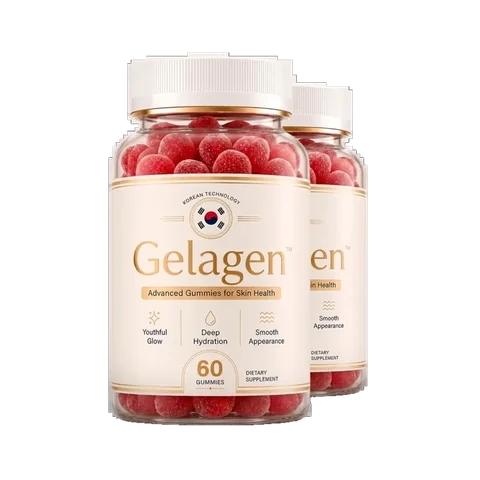
Gelagen is a chewable vitamin gummy. It carries thirteen named nutrients with thirteen printed amounts, which is more disclosure than most of this shelf offers and is the main reason it is possible to write about it honestly at all. What it is not is a substitute for anything in the five steps above, and it is not a collagen product despite a name that reads like one.
If you want the detail, it is elsewhere on this site rather than here: the thirteen amounts, the biotin and blood-test question, and the checklist that scores it against the same rows it would apply to a competitor. This page stops here on purpose.

Questions
Skin supplements: common questions
Does any supplement make skin glow?
Glow is not a measurement, so the question has no answer. What can be answered is narrower: correcting a genuine nutrient shortfall can change how skin behaves, and if there is no shortfall there is nothing to correct.
If 100% of the daily value is good, is 1,000% better?
No, and for some nutrients it is worse. The daily value is a labelling reference, not a target to beat. Water-soluble vitamins are largely excreted; fat-soluble ones such as vitamin A accumulate and carry an upper limit.
Should I take a supplement at all?
That depends on whether you are short of something, which is a question a clinician and a blood test can answer and a sales page cannot. Nothing on this site is medical advice.
Is a gummy worse than a capsule?
Not automatically, and it has one real advantage: people keep taking them. The trade is that the base has to taste good, so sugars, gelling agents, colours and flavours occupy most of the mass, and that base should be published.
Where do collagen supplements fit in this guide?
They do not, because this guide is about nutrients and a daily value. We take no position on whether collagen supplements work. If you came here after seeing a name that sounded like one, this post explains the words.
References
- National Institutes of Health, Office of Dietary Supplements. Vitamin A and Carotenoids: Fact Sheet for Consumers. https://ods.od.nih.gov/factsheets/VitaminA-Consumer/
- U.S. Food and Drug Administration. Daily Value on the Nutrition and Supplement Facts Labels. https://www.fda.gov/food/nutrition-facts-label/daily-value-nutrition-and-supplement-facts-labels
- National Institutes of Health, Office of Dietary Supplements. Zinc: Fact Sheet for Consumers. https://ods.od.nih.gov/factsheets/Zinc-Consumer/
Every source above was opened and read on September 22, 2026. None of them tested Gelagen itself. They describe the named nutrients and plants, which is a different thing from testing this finished formula.