Gelagen Blog
How to read a supplement panel in four minutes
Four passes. Serving size against servings per container, because those two lines scale every number under them. The amount column, then the percent Daily Value and where it comes from. The Other Ingredients line, which on a gummy matters most. Then the asterisk, the lot number and the certificate number. This panel is fully disclosed; its Other Ingredients line is missing.
By the Gelagen Editorial Desk at Gelagencare · Medical review: Dr. Brenda LaTowsky, MD · Revised
Minute one: the two lines at the top
Two lines sit at the top of a Supplement Facts panel, and everything printed underneath depends on both. Serving size says how much of the product counts as one serving. Servings per container says how many of those a bottle holds.
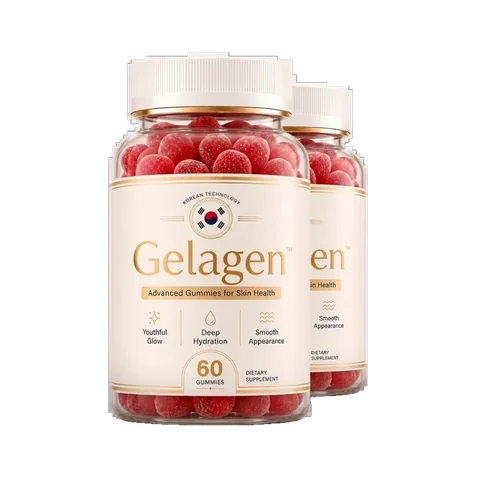
On Gelagen the serving size is 2 gummies and the servings per container is 30, out of 60 gummies. Those three figures agree: 60 gummies at two a serving is 30 servings, or 30 days.
Get this pass wrong and every number below it is wrong too. A panel declaring 5,000 mcg of biotin declares it per two gummies, not per gummy: chew one and you have had half of everything on it. The amount column is a rate, and the serving line is what it is a rate of.
Minute two: the amount column
The middle of the panel is a list of names with an amount beside each. The first question to ask of it is narrow: does every name have a number?
Here every one does. Thirteen nutrients are declared and thirteen amounts printed — Vitamin A at 630 mcg RAE, Vitamin C at 20 mg, Vitamin D at 10 mcg, Vitamin E at 7.4 mg, Vitamin B6 at 2 mg, Folate at 442 mcg DFE, Vitamin B12 at 6 mcg, Biotin at 5,000 mcg, Pantothenic acid at 5.2 mg, Choline at 0.04 mg, Iodine at 42 mcg, Zinc at 2.7 mg and Inositol at 40 mcg.
Read the units as carefully as the digits. Micrograms and milligrams differ by a factor of a thousand and both appear here. Folate is printed in mcg DFE, dietary folate equivalents, which is the correct unit rather than a plain microgram figure. Vitamin E names d-alpha tocopheryl acetate, the natural-source form rather than the synthetic dl-alpha.

What a percent Daily Value actually is
Beside the amount column most panels print a second column: percent Daily Value. It is one piece of arithmetic: the declared amount divided by a reference figure the FDA publishes for that nutrient.
The FDA publishes the whole Daily Value table, and every percentage on every supplement panel in the country comes out of it. Daily Values are labelling reference figures, not a personal recommendation, and a percentage near 100 does not mean a dose is right for you.
That matters here, because no percentage column was published with this label. The percentages on this page are computed from the FDA Daily Values, not copied from the bottle. The listing gave amounts and no percentage column. Every percentage on this site is therefore ours.
| Nutrient | Declared amount | FDA Daily Value | Percent of the Daily Value |
|---|---|---|---|
| Vitamin A | 630 mcg RAE | 900 mcg RAE | 70% |
| Zinc | 2.7 mg | 11 mg | 25% |
| Biotin | 5,000 mcg | 30 mcg | 16,667% |
| Choline | 0.04 mg | 550 mg | 0.007% |
“Daily Value not established”
Some ingredients have no Daily Value at all. When one appears on a panel, the percentage column carries a symbol and a footnote reading that a Daily Value has not been established.
Here that applies to inositol, declared at 40 mcg. No reference figure exists, so no honest percentage can be printed beside it, and none is printed on this site either.
The footnote says only that the FDA reference table has no entry for that substance, which is true of many ordinary ones. What it does mean is that the single tool you have for putting an amount in proportion is unavailable on that line, leaving a bare number. Forty micrograms is small by any measure, and where inositol has been studied in humans the doses are measured in grams.
The line that settles arguments
These statements have not been evaluated by the Food and Drug Administration. This product is not intended to diagnose, treat, cure, or prevent any disease. Every asterisk on the front of a supplement leads to this sentence, and it is required rather than optional. A supplement may say it supports a normal body function. It may not say it treats, cures or prevents a disease.
Minute three: Other Ingredients, and why a gummy makes it matter
Underneath the Supplement Facts panel, usually in the smallest type on the bottle, sits a line headed Other Ingredients. It lists everything in the product that is not a declared dietary ingredient: the base, the binders, the gelling agents, the acids, the colours, the flavours and the sweeteners.
On a gummy it is the most informative line on the label, because a gummy is mostly not its actives. Read it and you learn three things the panel above cannot tell you: how much sugar is in a serving, whether the gelling agent leaves the product unsuitable for vegetarians, and which colours were used.
On Gelagen that line is not published. We print those two words rather than inventing a list. It is the largest gap on this label, and on a gummy it is the gap that matters most.
Proprietary blends against full disclosure
One panel format removes the amount column entirely. A proprietary blend prints several ingredient names under one heading with a single total weight and no individual figures. It is legal, it is common, and it withholds one thing: how much of each ingredient a serving contains.
Full disclosure is the opposite. One name, one amount, on every line.
Gelagen does it. Thirteen nutrients, thirteen printed amounts, no blend line anywhere on the panel. That is the best thing about this label and it deserves saying first. Full disclosure is the thing to demand of any supplement, because it is what makes every other question answerable: you cannot ask whether a dose is sensible until the dose is printed. It is not a guarantee that the amounts are good ones. It is a guarantee that you can find out.

Minute four: the asterisk, and what it is attached to
Somewhere on the front or side of almost every supplement there is an asterisk, and somewhere in small type there is the sentence it leads to. It is quoted in full in the box above.
That sentence is required rather than optional, and it is attached to a particular kind of claim. A supplement may say it supports a normal body function; the category is called a structure or function claim. It may not say it treats, cures or prevents a disease. The front of this bottle carries youthful glow, deep hydration and smooth appearance, which sit on the structure and function side of that line.
The FDA sets out two things behind the asterisk. It does not have the authority to approve dietary supplements before they are marketed, so there is no pre-market review of a formula. And the responsibility sits with the firm, which must have substantiation that a claim is truthful and not misleading.
Lot numbers, certificate numbers and dates
Three short codes finish a label, and each answers a different question.
The lot number identifies the batch, and it is the handle you have if a product is recalled. This one prints GEL-26/GE-6014.
The certificate of analysis number points at a third-party test of that batch. This one gives GEL-6014-26-GE. A number is not a document: what has been published is the reference, not the results.
A best-before date is the third, and here it is not published. That is the code a gummy most needs, because a gummy base changes over months in a way a capsule does not. When a code is missing, write down which one.
The four-minute checklist
Six passes, in order, and none needs anything you do not already have.
Read the serving lines first
2 gummies and 30 servings, from 60 gummies. Every amount below those two lines is per serving, not per gummy.
Check that every name has a number
Look for a name with no figure beside it. On this panel there is none.
Work out one percentage yourself
Biotin, 5,000 mcg against a 30 mcg Daily Value, is 16,667 percent. One division tells you more than the whole front of the bottle.
Read the Other Ingredients line
On a gummy this describes most of what you chew. Missing here, so the sugar load, the gelling agent and the colours are all unknown.
Find the asterisk
It marks the boundary between a structure or function claim and a disease claim.
Write down the codes, and the absent ones
Lot GEL-26/GE-6014 and certificate GEL-6014-26-GE are printed. A best-before date is not published.
Try Gelagen with 60 days to change your mind
Two bottles is $79 each and lasts exactly 60 days, which is the only pack that matches the guarantee window. Three brings it to $69 a bottle with free US shipping.
Add to cart, $158 for 2 bottles
Checkout happens on the seller’s secure page. After you order, the desk listed in the footer handles tracking and refunds.
References
- U.S. Food and Drug Administration, reference table: Daily Value on the Nutrition and Supplement Facts Labels. https://www.fda.gov/food/nutrition-facts-label/daily-value-nutrition-and-supplement-facts-labels
- U.S. Food and Drug Administration. Questions and Answers on Dietary Supplements. https://www.fda.gov/food/information-consumers-using-dietary-supplements/questions-and-answers-dietary-supplements
Every source above was opened and read on September 30, 2026. None of them tested Gelagen itself. They describe the named nutrients and plants, which is a different thing from testing this finished formula.
Keep reading
Next on this site
Biotin and blood tests: what the 5,000 mcg on your bottle means
Why hair and nails products carry 5,000 mcg of biotin, how biotin interferes with some blood tests, and the one sentence to say before any test.
What collagen supplements are, and how to tell if you have one
What collagen is, why vitamin C matters for your own, what a collagen supplement contains, and how to check any bottle in about ten seconds.
The Gelagen label, transcribed
The printed panel line by line, with every amount, every computed percentage and a list of what the label does not say.